
Biography
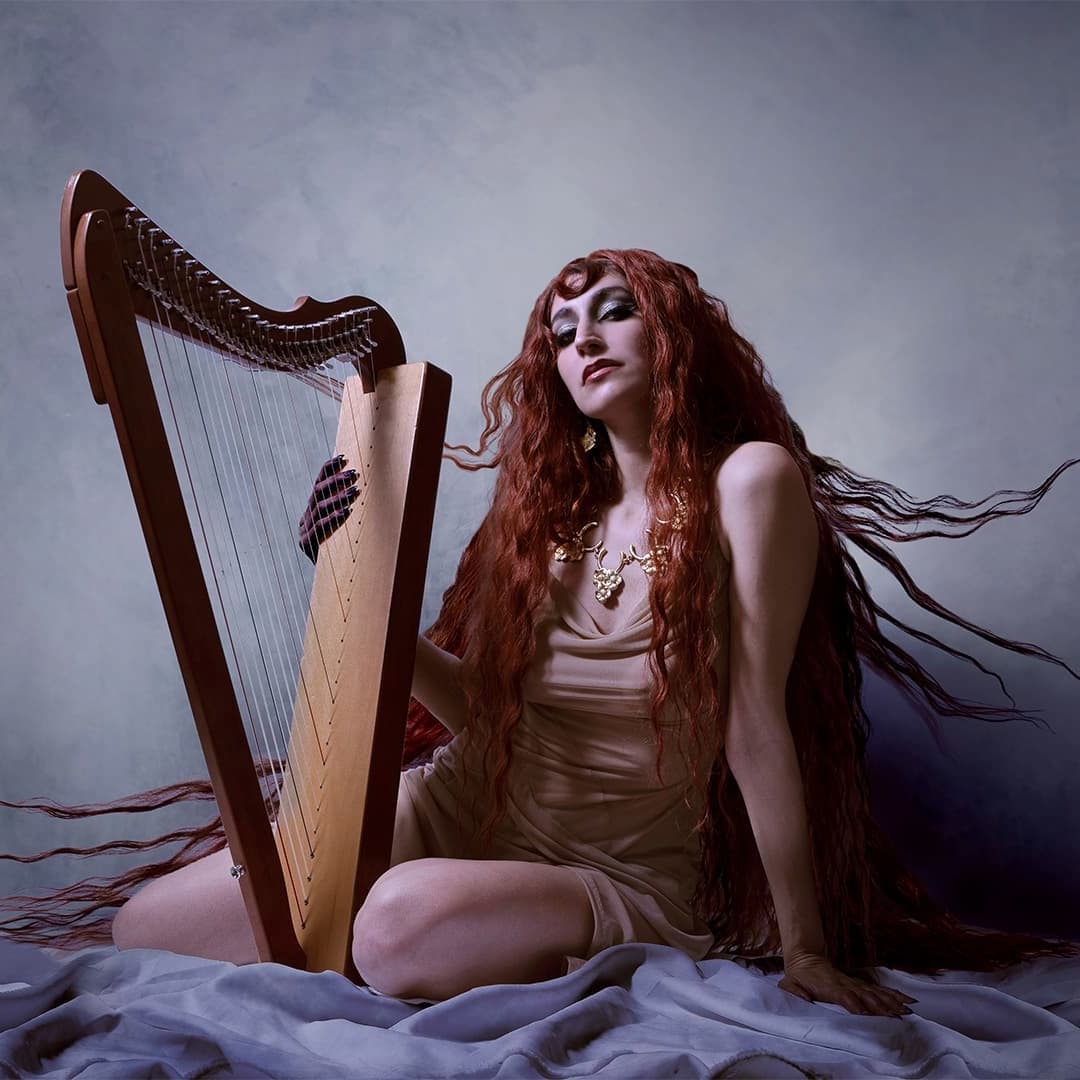
Musgö is a harpist and singer from Cádiz with a distinctive artistic voice, blending harp, electronic textures, folk influences and pop sensibility into a sound that feels both ancestral and contemporary. With over a decade of live experience, she writes her own music and lyrics and shapes the visual universe surrounding her work.
Her live performances are immersive and hypnotic, where acoustic and electronic elements merge seamlessly, placing the harp and her unique voice at the center of the experience.
After releasing her debut album “Open the Gate” (2019) and composing the soundtrack for theRTVE Playz series Grasa in 2021, Musgö presented “Un sendero” (2023), her first fully Spanish-language album, recognized by Mondosonoro as one of the best World Music albums of the year. In 2025 she released “La grieta“, a conceptual record co-produced with Ramiro Gómez, exploring the intersection of electronics, Andalusian folklore and classical influences in a powerful and emotionally transformative sonic journey.
Hueco Session #07
Musgö recorded a live session at Hueco Studio in February 2026 as part of the Hueco Sessions in Cantillana, near Seville.
Musgö at Hueco Studio: the harp as altar, roots and ceremony
Some artists come on stage to play songs. Others seem to open up a space.
With Musgö, the live performance feels like a concert, but also like a ceremony. The Cádiz-born artist, harpist, singer and producer came to Hueco Studio for an intimate session where the harp, voice, synthesizers and stage presence built something that went beyond music.
After the session, we sat down with Mar, the person behind Musgö, to talk about her beginnings, her relationship with the harp, the energy that runs through her music and the increasingly conscious pride of carrying Andalusia with her.
Music as play
Musgö remembers her first approach to music from a very young age, when she started taking piano lessons. But that first experience was not exactly academic.
Her teacher would give her sheet music. She would listen to the song, remember the parts she liked and then play it her own way.
“Having to do what a piece of paper told me seemed absurd.”
Since then, her relationship with music seems to have been closer to intuition than obedience. For Musgö, music does not come only from theory, but also from play, emotion, energy and mystery.
“Music is meant to be played. As they say in English: play music.”
That idea runs through all of her work. It is not about denying technique, but about understanding that there are many ways into music. Some go through the conservatoire. Others go through intuition, the body, listening or the need to express something that does not yet have a shape.
The stage as an altar
During the conversation, a powerful image appears: Musgö as a kind of musical priestess.
She explains that it was not something planned from the beginning. Rather, it started to appear naturally in her concerts. People in the audience would tell her that they felt a shift in energy, that something transformative happened during her live shows.
Over time, Musgö decided to accept that reading and give it shape.
“I started treating the artistic and stage space as a place of worship.”
In her live performance, each element seems to occupy a symbolic place: the harp, the body, the keyboard, the objects, the light, the voice. Everything forms part of the same space.
It is not decoration. It is narrative. It is intention.
“In the end, I have given names and symbols to something that was already happening.”
At Hueco Studio, that idea fitted very naturally. A small room, a close audience, silence, attentive listening and a staging that turned the studio into something close to a small sonic temple.
A love at first sight with the harp
Although the harp is often associated with classical music, the celestial or very specific imagery, Musgö has built her own language with it.
Her relationship with the instrument began almost like an apparition.
At 13, while working on a school project about construction materials, she searched for images on Google. Among bricks, cement mixers and materials, an image of a harp unexpectedly appeared.
“When I saw that image, it was like seeing someone you don’t know, but instantly knowing they have something special.”
She did not know how to play it. She did not even really know what that instrument was called. But she was sure.
“I told my father: I want a harp. I’m going to dedicate myself to this. This is going to be my life.”
From that moment on, the harp stopped being something distant and became the centre of her creative universe. Not as a delicate or untouchable object, but as an open tool.
Musgö speaks of the harp as a magical instrument, yes, but also as an instrument capable of holding many emotions and styles. Something that can sound sweet, but also dark. Soft, but also intense.
“From the very beginning, I always liked pushing it, seeing how far it could go.”
Producing from within
Beyond the harp, there is another essential element in her process: Logic.
Musgö produces her own music, works with samples, builds layers, experiments and dives deep into sound. Her universe cannot be understood only through the acoustic, but through the constant dialogue between the organic and the digital.
“Logic, my inseparable friend.”
That combination is part of what makes her project so particular. The harp lives alongside electronic textures, atmospheres, processed voices and a very personal way of understanding production.
For Musgö, today’s tools allow anyone with creativity to begin building their own sonic world from a room. There is no need to wait for a big structure behind you in order to create something of your own.
Taking care of a song’s energy
One of the most interesting parts of the interview comes when Musgö talks about her creative process. For her, writing, recording and singing are not neutral gestures. Every moment contains an intention.
When she enters the studio and stands in front of the microphone, she is aware that this instant will be recorded and listened to by other people.
“That moment is going to be consumed by a lot of people who are going to take it deep into their brains.”
That is why she takes care of where she sings from, what energy she brings and what intention she is sharing. Even if the melody is the same, the way she inhabits it can change everything.
“Even if I sing the same thing, in the end it is like a prayer, a meditation.”
In her latest work, that awareness has been especially important. Musgö talks about songs crossed by grief, darkness and pain. For a long time, she felt that her music had to offer something beautiful, bright or gentle. But in this process, another need appeared: to also hold what is difficult.
It was not about simply sharing pain.
“If it’s ‘I share my pain so you can swallow it’, I’m not interested.”
The question was different: what can a dark song offer if it is shared with care? How can a space be opened where those emotions can exist in a sacred way?
From pain to the live show
When those songs reach the stage, something changes.
Musgö explains that she no longer necessarily feels like the grieving person who wrote those songs. Live, she occupies another place. She does not relive the pain in the same way: she holds it.
That difference matters. The concert is not an exact repetition of the moment in which the song was born, but a new way of relating to it.
In intimate spaces like Hueco Studio, that transformation can be felt very clearly. There are no big artifices to hide behind. There is not enough distance to disguise anything.
“It’s just you, your music and the people.”
For Musgö, this kind of format has something very special. In a large venue or theatre, you often cannot see people’s faces. In a small space, you can. You see the tears, the gestures, the silences. You can even hear how people breathe.
“All emotions come to the surface.”
Aesthetics, character and storytelling
Musgö also has a very defined aesthetic. The way she dresses, moves, looks and occupies the stage is part of the same language as her music.
For her, the visual does not replace the musical, but it does help complete the story. In a context where we consume music in an increasingly audiovisual way, image also speaks.
“It is a tool to complete the story of what you want to tell.”
She compares it to theatre: before a character even speaks, we already understand something through how they walk, dress or position themselves on stage.
In Musgö, that visual dimension does not feel like a costume, but like an extension of her inner world. A way of giving body to what is already sounding.
Social media without getting lost in it
The interview also touches on a very present topic for any artist today: social media.
Musgö explains that it stopped wearing her down when she learned not to take it so personally. Before, her life, her person and her artistic project were too mixed together. Now she tries to separate them more and turn it into something closer to a game.
“It stopped wearing me down when I stopped taking it personally.”
That distance allows her to use social media as a creative tool, not just as a source of pressure. She even talks about how artificial intelligence can help organise campaigns, plan content or release part of the mental load that comes with promoting a release.
But the key is not to lose the centre. Social media can accompany the project, but it cannot replace it.
Andalusia as a root
Towards the end of the conversation, one of the strongest themes appears: Andalusia.
Musgö talks about the growing pride she feels for her culture. Born in Chiclana, near Cádiz, she feels that travelling and playing outside Spain is helping her look at her origins with more perspective.
“Going outside is helping me feel increasingly proud of being Andalusian.”
She explains that, at first, she felt a certain external pressure. She played the harp, sang in English, listened to Massive Attack and Portishead, and still people would ask her whether she played flamenco. As if an Andalusian artist always had to respond to a specific expectation.
Over time, that relationship changed. Not from obligation, but from discovery.
“I’ve been discovering an enormous castle I was living in, and it was a fucking palace, but I hadn’t realised it.”
That is where one of the most beautiful reflections of the interview appears. Musgö talks about the accent, Cádiz, the Mediterranean, cultural crossings, art, esotericism and everything that has passed through Andalusia over centuries.
Her claim is not folkloric in a superficial sense. It goes deeper. It has to do with recognising the value of a culture that has often been reduced to stereotypes.
“A small reminder of where the spring of Spanish culture comes from.”
A session between the intimate and the sacred
Musgö’s visit to Hueco Studio had something very special. It coincided with a celebration of Andalusia and the session was full of gestures towards our roots, but from a contemporary, free and deeply personal place.
In her music, the harp, electronics, voice, body, image and a way of understanding the stage as a space of transformation all coexist. The intimate and the symbolic. The ancestral and the digital. Andalusian roots and a sensitivity open to the world.
Musgö does not play the harp to sound classical, nor does she use spirituality as decoration. Her project seems to come from a deeper need: to turn music into a place where one can play, invoke, hold and share.
At Hueco Studio, that place opened up close. Without distance. With people right in front of her. With emotions on the surface.
A conversation about intuition, grief, production, aesthetics, energy and Andalusian pride. And a session that, for a while, turned the studio into an altar.