
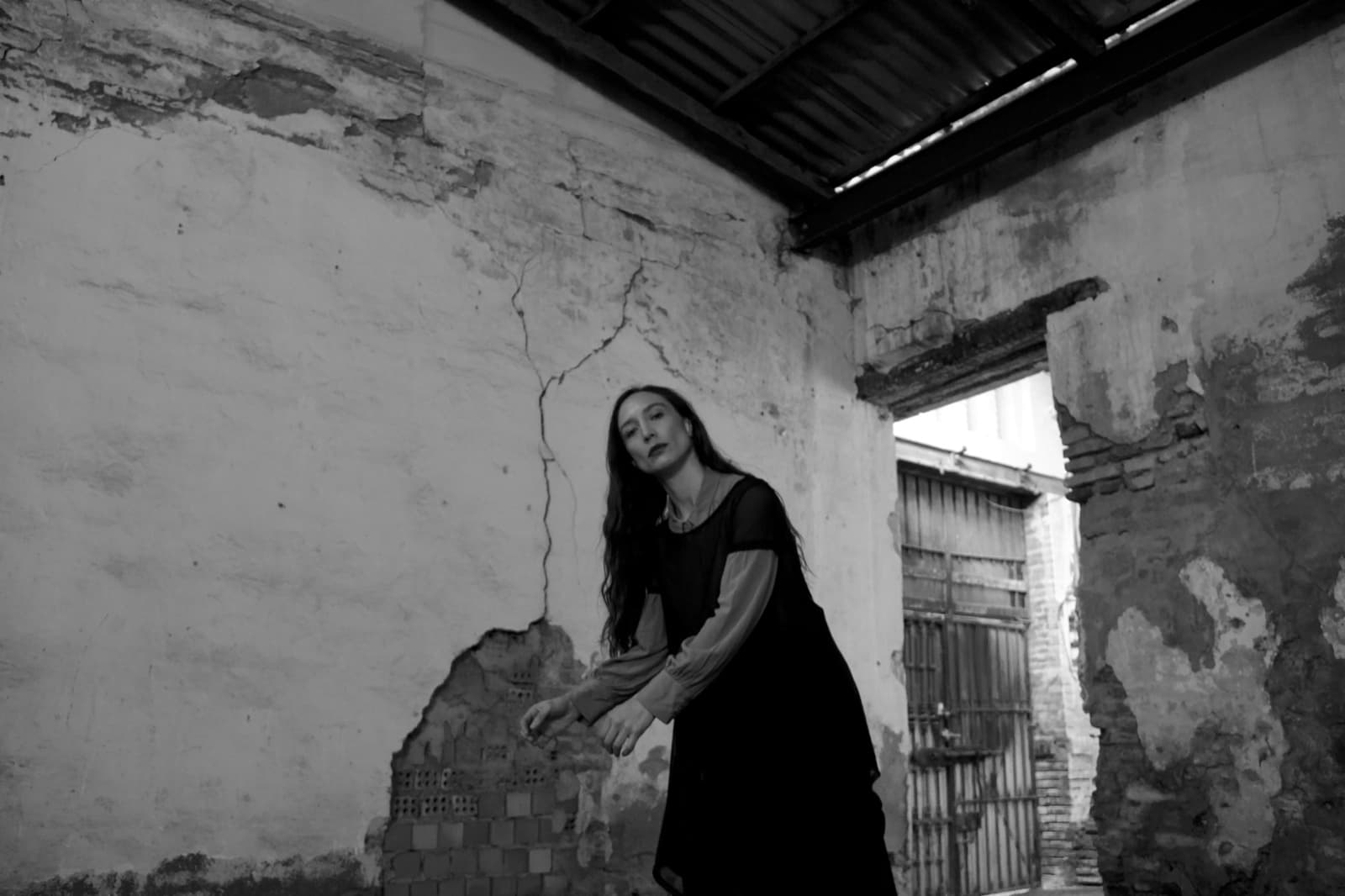
Biography
I.O. is the musical project of Chilean singer, cellist and composer Isidora O’Ryan.
Isidora draws inspiration from electronic processes that she uses in her voice, along with experimentation with textures and rhythms, strings and sampling; creating songs that are sometimes dynamic and danceable, as well as sometimes emotive and poetic.
I.O. has released three albums under the Sello 11:11 label: “Ciénaga“, released in 2020; “Blanco“, in collaboration with pianist and composer Juan Pablo Abalo, released in 2022, and “Altar“, released in 2023, which won her the award for Best Electronic Music Artist at the Pulsar 2024 Awards.
Hueco Session #01
I.O. recorded a live session at Hueco Studio in June 2024 as part of the Hueco Sessions in Cantillana, near Seville.
I.O. at Hueco Studio: cello, electronics and the search for a voice of her own
Some first times mark the beginning of a path. I.O.’s session at Hueco Studio was one of them: the very first Hueco Session, the starting point of a series of intimate encounters where music is heard up close and the space becomes part of the experience.
After the live performance, we sat down with Isi, the artist behind I.O., to talk about her way of understanding the stage, the evolution of the project, the role of cello and voice, and the mix of sensitivity, electronics and experimentation that runs through her music.
“It felt very comfortable. The atmosphere was really pleasant, the people who came, how you treated us, how you received us… it was a real luxury.”
From the very beginning, the conversation revealed something important: I.O. is a project in motion. A place where instrumental training, composition, electronics, work with producers and the need to find new ways of bringing songs to the stage all coexist.
Defending the project on stage
One of the biggest challenges for I.O. has been the live performance. Isi comes from playing in bands, orchestras and chamber music settings, contexts where you are part of a larger group and the attention is shared.
With this project, everything changes. Stage presence becomes more visible, more frontal, more exposed.
“The biggest challenge is getting on stage and defending the project.”
That line sums up an important part of the process. I.O. is not only music composed in the studio: it is also something that has to be held with the body, the voice and presence.
The evolution of the project can also be understood from there. At the beginning, the live show was performed with a band or ensemble of seven people on stage. Now, living in Seville while the band is in Chile, she has had to rebuild the set, adapt it and face a more solitary way of occupying the space.
“The whole band is in Chile, so I’ve had to build a completely new set.”
That adaptation is not only logistical. It also transforms the way the songs are inhabited.
Finding inspiration in the surroundings
When talking about influences, Isi does not point to one specific reference. Instead, she understands inspiration as something that filters in from many places: records, concerts, walks, conversations, events and emotions.
“From the surroundings, from going to a concert, from walking in the morning, from walking at night, from a conversation…”
Her way of composing does not seem to follow a closed method. There is something very intuitive, even unconscious, in the way what she listens to, lives or feels eventually appears in the music.
“Everything influences me a lot.”
That openness can be heard in I.O.’s sound: music that does not fully belong to one single place, but moves between layers, textures, voice, cello, electronics and pop sensitivity.
From chaos to a more organised way of creating
In the studio, Ableton Live has become a fundamental tool for I.O.
“I use Live a lot to make music.”
Isi explains that for a long time her process was quite chaotic. Ableton allows you to open endless tracks, record ideas, layer sounds and keep trying things. That can be liberating, but it can also become a maze.
“I would just record and record and record… and then it was chaos.”
Over time, she has been learning to organise herself better. Instead of getting lost among too many ideas, she now tries to create more focused sessions: working on the rhythmic section, trying new rhythmic ideas, starting from lyrics or changing the starting point of a song.
That change is also part of the project’s growth. Learning to take care of an idea so it does not get lost. Learning to bring order without turning off intuition.
Starting from emotion, starting from words
Although she does not have a fixed methodology, Isi recognises that she often begins composing from a strong emotional place. Something that moves her, that engages her, that forces her to enter the song from a sensitive place.
But she is also trying other routes.
In the interview, she talks about recent exercises where she starts from a poem, such as one by María Monvel, a Chilean writer from the early 20th century. Starting from words completely changes the music that appears.
“The music is completely different when you start from the lyrics.”
That gesture opens up an interesting path: not always composing from the same place, but changing the entry point. Sometimes from rhythm. Sometimes from cello. Sometimes from emotion. Sometimes from a text written by someone else.
Cello, voice and electronics
I.O. is built from several centres. Cello and voice are two fundamental axes, but they do not work alone. Around them appear Ableton Live, VSTs, samplers, synthesizers, producers and a very careful work on texture.
“I think that without Ableton I wouldn’t have made this project.”
That line matters because it explains how electronics is not an ornament, but a condition of possibility. Ableton allows her to build layers, try structures, transform sounds and expand what cello and voice can do.
In the final stages, there is also work with other musicians and producers. After creating with digital tools, there comes a moment to enter the studio, record with real synths, try ideas with other people and let the songs grow.
“There is always that stage of going into the studio and recording with real synths.”
That mix between the organic and the electronic is one of the keys to I.O. A proposal where the acoustic instrument is not opposed to digital production, but coexists with it.
Experimental electronic pop
When the question of labels comes up, Isi answers with a formula that feels open enough:
“Experimental electronic pop.”
The definition works because it allows many things to fit inside. Pop, understood generously. Electronics, present in the records and in the creative process. And the experimental side, as a space that keeps the project from closing in too much.
“Experimental, so there is no doubt.”
I.O. is not looking for a rigid label, but she does seem to move in a recognisable territory: sensitive songs, electronic textures, vocal treatment, cello, sonic layers and a constant interest in trying things out.
From the first album to Altar
The conversation also reveals a clear difference between the first album and the second one, Altar.
The first work had a more melancholic, intimate and sensitive character. With Altar, however, Isi was looking for something more physical, more active, more extroverted.
“I wanted it to be punchier, more active, to make you move a little more physically.”
That desire marks an important evolution. It is not about abandoning sensitivity, but about taking it somewhere else. Allowing the music to move the body too, not only the emotion.
The name Altar suggests a space of offering, but the sound seems to open more outward. An album with more movement, more presence and a less withdrawn energy.
Patience, work and resilience
Towards the end of the interview, a very clear reflection appears about what it means to sustain an artistic career.
When asked what advice she would give to someone starting out, Isi does not speak about magic formulas or quick success. She speaks about patience, work and trust.
“You have to be very patient, you have to trust what you do.”
She also talks about studying, insisting, working and being resilient. Because there are moments when you feel depressed, lose meaning or doubt the path. But even then, you have to keep going.
“You have to keep going, keep going and keep going.”
It is a simple line, but it sums up a less glamorous part of making music: consistency. Continuing even when not everything is clear. Continuing when the project is still transforming. Continuing when you have to rebuild the live show, move countries or start again from somewhere else.
Sharing music live
Looking ahead, I.O. wants to keep making records, experiment without boxes, collaborate with other musicians and producers, travel and share her music with new audiences.
But one idea appears with particular strength: sharing music live.
“Sharing music live with people makes a lot of sense to me.”
After having opened the very first Hueco Session, that line takes on a special meaning. Because that was precisely what the first session was about: placing music in the middle, bringing it closer to people and creating a space where the live performance could be felt in another way.
I.O. opened Hueco Sessions with a proposal where cello, voice and electronics meet in an intimate and experimental place. A conversation about adaptation, creative process, sensitivity and the patience needed to keep building a voice of her own.