
Biography
Helicóptero BOOM is one of those bands that seem to appear without asking for permission. Young, Seville-based and hard to place under a single label, they move between pop rock, garage and noise, with ’90s echoes that may bring to mind bands like Dinosaur Jr., but filtered through a punk, unpolished and very personal attitude.
Their music blends pop melodies with sharp guitars, moments of noise and a raw energy that finds its natural place on stage. Live, Helicóptero BOOM are not trying to sound perfect or please everyone: they are trying to make something happen. There is intensity, freshness and the feeling that anything could take place at any moment.
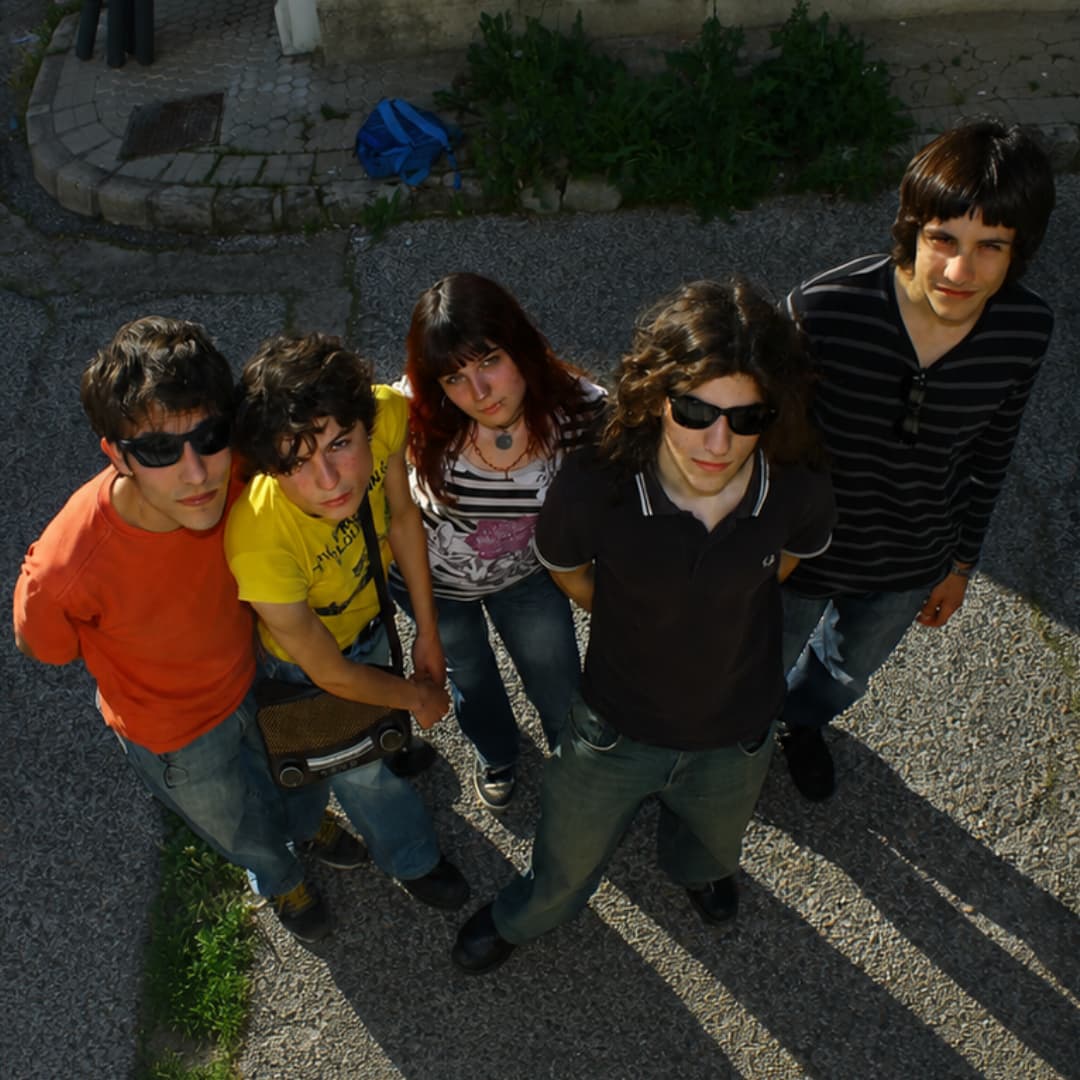
The band is formed by Mario Vega, Julia Valero — also known as Julia de Arco —, Berta Acosta, Marcos Amodeo and Adriano Hernán. Together, they have been building a project defined by a constant search for identity, moving away from fixed formulas and leaning into a sound that feels increasingly their own.
That journey took shape in “ALBOOM“, their first album: an honest, direct and home-made record that marked a turning point in the way the band understood their own sound. So much so that Helicóptero BOOM decided to leave behind previous material that no longer represented the image or direction they wanted to project.
The band is currently working on new songs and preparing to record an EP that aims to further define their identity within the music industry, without losing freshness, risk or instinct. For this new stage, they will be working with Paco Loco, a collaboration that fits naturally with their way of understanding music: direct, free and with very few concessions.
Helicóptero BOOM have already played key venues in Seville’s music scene, such as Fun Club, EVEN and La2, as well as festivals like Monkey Week. Their path is still growing, but the idea is already clear: making songs that are best understood when experienced up close, live and unfiltered.
Hueco Session #10
Helicóptero BOOM recorded a live session at Hueco Studio in May 2026 as part of the Hueco Sessions in Cantillana, near Seville.
Helicóptero BOOM at Hueco Studio: energy, noise and their own way of being together
Helicóptero BOOM arrived at Hueco Studio with guitars, synthesizers, drums, bass, voices and the kind of energy that cannot be prepared too much in advance. The Seville-based band, formed by Mario Vega, Julia Valero, Berta Acosta, Marcos Amodeo and Adriano Hernán, came to Hueco Sessions #10 to record a live session that felt part concert, part open rehearsal and part celebration between friends.
After playing, we sat down to talk about the origins of the band, their way of writing songs, noise, lyrics, live shows and that mix of chaos, humour and honesty that runs through everything they do.
Because Helicóptero BOOM does not feel like a band built from a closed idea. They sound more like a group discovering itself while playing.
“We are very much ourselves.”
And maybe that is the key.
A house, a band and the audience very close
The interview started with a shared feeling: having played in a different kind of place. Hueco Studio is not a conventional venue, nor a cold studio. It is a house-studio, and that makes music happen in a different way. The audience is close, the band plays almost at eye level, and the distance between concert, conversation and shared experience becomes very small.
“We felt super comfortable, kind of like at home.”
There is something literal in that sentence. At Hueco Sessions, music happens inside a house, but also inside an atmosphere that invites people to let their guard down a little. For Helicóptero BOOM, used to venues, stages and concerts where movement is usually part of the show, this more intimate format changed the way everything was heard.
“We are literally in a house and you can feel it, because everything is really welcoming.”
In a space like this, the energy does not disappear: it becomes concentrated. The band could not expand physically in the same way they would in a venue, but that limitation made everything feel closer. The noise, the looks, the songs and the audience were all sharing the same air.
The origin of an impossible name
The story of Helicóptero BOOM begins almost like important things often do before anyone knows they are important: through play.
A drum kit at Julia’s house, a newly learned guitar, someone singing, a bass that appears through family inheritance and a version of Johnny B. Goode. From there, the first fantasy of having a band was born.
“I started telling all my friends that I had a band.”
The name came later, completely unexpectedly. A friend asked what they were called. They did not have a name. He answered with something that could have remained an absurd joke, but somehow became an identity.
“He said: you have to call yourselves Helicóptero Boom.”
Later, the group stopped, came back together to play covers at a family wedding and, almost without fully deciding it, started becoming something more real. Or more constant. Or more their own.
“We are not serious, but it felt like a cool project, like: let’s keep rehearsing and writing songs.”
That balance between not taking themselves too seriously and, at the same time, really caring about what happens when they get together, says a lot about the band.
A sound they do not search for: it appears
When talking about Helicóptero BOOM, it is easy to reach for labels: pop, punk, garage, psychedelia, noise, nineties rock, synthesizers, twisted melodies, live energy. But listening to them speak, it becomes clear that their sound does not come from a formula.
It does not feel calculated. It feels more like a consequence.
“It is inevitable to end up with that sound.”
Each member brings a different way of playing, listening and reacting. What happens when all of that comes together is what ends up becoming the band.
“When everyone plays what they want and we put it all together, it sounds like that.”
That is why their songs are hard to pin down. There are guitars pushing forward, synthesizers opening up textures, bass and drums holding the impact, voices moving between melody and chaos. Everything coexists without needing to explain itself too much.
Helicóptero BOOM sound like a mixture, but not like a collage. They sound like five people finding a common language by playing together.
Songs that change shape
In the interview, the band explains how their creative process has changed over time. Sometimes someone arrives with an idea, a guitar part, a melody or a demo. But that first version almost never survives untouched.
“We really improvise. And from there, we try to get whatever comes out.”
There is something very alive in that way of working. Songs pass through the group, get reshaped, tested, discussed, stretched and put back together. An idea might look terrible from far away, but they still try it before throwing it out.
“Whatever is suggested, we try it.”
That sentence sums up a way of being in a band: trusting each other enough to let songs change hands. Not protecting the first intuition too much. Allowing the others to touch it, contradict it or take it somewhere else.
With Noferatu, for example, the change was radical.
“Noferatu has nothing to do with the original demo.”
That is one of the most interesting things about Helicóptero BOOM: the song is not a closed object, but something in motion. Something discovered in rehearsal, through mistakes, insistence and the energy of the group.
Influences that collide and make sense
When they talk about references, each member seems to come from a different place. The nineties appear, along with electronic music, disco, indie, Los Planetas, noise rock, Sonic Youth, Dinosaur Jr., math rock and post-hardcore.
“I’m really into disco. I’m really into dancing.”
That diversity does not come across as an ordered list of influences, but as a natural coexistence. Helicóptero BOOM are not trying to sound exactly like any of those things. Instead, they let all of them pass through the room and collide with each other.
What comes out is music that can be noisy and catchy, chaotic and bright, raw and fun. Songs that do not hide their seams, but do not rely only on disorder either.
There is humour, yes. There is noise too. But underneath, there are songs.
Así sonríen las alemanas: irony, sound and presentation
During the conversation, Así sonríen las alemanas, the band’s new EP, also comes up. When they talk about the lyrics, Helicóptero BOOM do not present the record as a closed manifesto or as a set of songs with one single message.
They describe it instead through imagination, irony and a certain freedom to let words appear from the sound itself.
“The EP is more fantastical.”
“It has an ironic touch, but it says things.”
There is something abstract in the lyrics, sometimes satirical, sometimes simply phonetic. Words that arrive because they sound good. Phrases that are almost murmured before finding their place in the song. Titles that influence a track and end up opening a small world.
“I’m guided a lot by what sounds good phonetically.”
“Literally whatever comes out.”
That way of writing connects with the rest of the project. Helicóptero BOOM do not seem to need to explain everything. They prefer to suggest, exaggerate, break logic a little and let meaning appear afterwards, if it needs to appear.
The EP works as a kind of introduction: not so much “this is what we want to say”, but “this is who we are when we play together.”
Playing small, sounding clearer
One of the clearest differences at Hueco Sessions was the format. Helicóptero BOOM usually play in venues, at concerts and in contexts where the audience can jump, dance or start a pogo. At Hueco Studio, the space was much smaller and the listening much closer.
Far from switching off the energy, that closeness moved it somewhere else.
“The energy is concentrated.”
The band also noticed something important in the sound. By playing with more control, in a space recorded with care, details appeared that can sometimes get lost in the volume of a venue.
“It sounded so much better.”
“For the first time, I could hear all the instruments.”
That change gave the session something special: it was not a domesticated concert, but it was not an overflowing live show either. It was the same energy, but focused. Less dispersed. Sharper.
“It was a bit like singing directly to them.”
In a band like Helicóptero BOOM, that lets you see both layers: the force of the live performance and the detail of the songs.
Giving it all, even if something breaks
When asked what they would like people discovering them for the first time to take away, the answer always returns to one word: energy.
“The cool thing to transmit is the energy.”
For Helicóptero BOOM, a concert can go better or worse. It can sound cleaner or rougher. A string can break, something can fail, a moment can slip out of control. But there is one intention that remains: to keep pushing.
“People leave with good feelings because they have seen us giving it everything.”
That sentence says a lot about the band. They are not looking for distant perfection, but presence. Being there, playing with the body, smiling, pushing forward and turning each concert into something that is felt, even when it does not go exactly as planned.
Maybe that is why their live show works: because it does not try to hide the accident. It includes it.
Energy and chaos
At the end of the interview, when they try to sum up what Helicóptero BOOM means to each of them, the conversation becomes exactly like the band: fast, chaotic, funny and hard to organise.
Words appear: energy, chaos, authenticity, flavour. They interrupt each other, laugh, start again and end up accepting that this way of answering also represents them.
“I would honestly be worried if we answered like robots.”
“We are authentic.”
“This interview is the clearest example that we are authentic.”
And that is probably true. Helicóptero BOOM did not come to Hueco Studio to leave behind a perfect image, but a living one: a young, intense, noisy, funny band, very aware — in their own way — that what matters happens when they get together and start playing.
Hueco Sessions #10 captures exactly that: the moment when chaos finds shape, songs gain body and a house-studio in Cantillana becomes, for a while, the centre of a small explosion.