
Biography
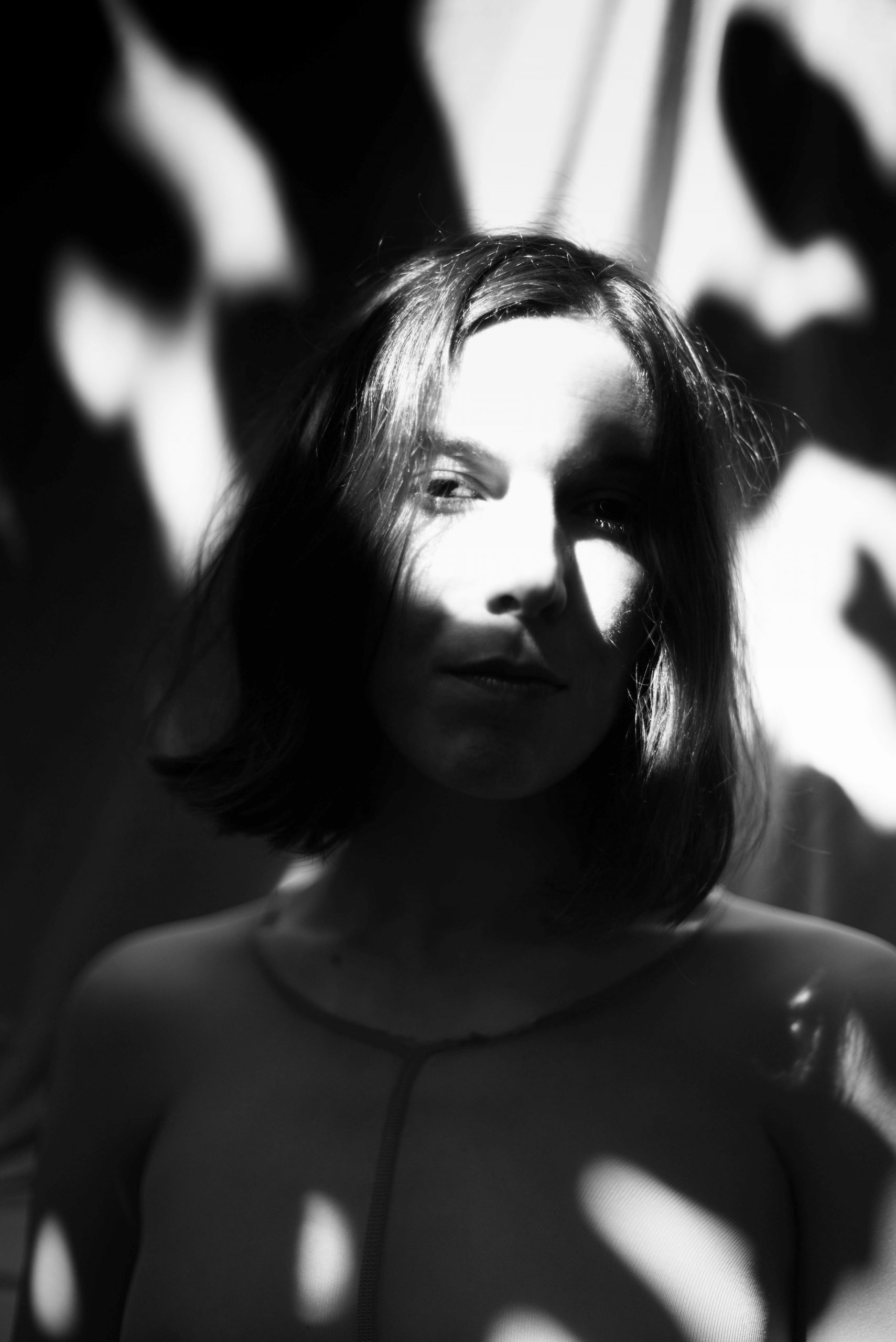
Elisa-Irini Vidalis, known artistically as CALMDOWN, is a multifaceted Greek-born music producer, singer-songwriter, and videomaker who has been making waves in the underground scene. Her unique blend of electronica, art pop, and trip-hop has earned her collaborations with notable figures like Howie B (Björk, Brian Eno, U2, Tricky). Most recently, Howie B remixed her single, “Seasalt Symphony – Part I/ Preface.“
Her latest project, “PRISONER K”, was selected for funding, enabling her to complete her upcoming album, “PINK“, the third part of her ambitious trilogy, slated for release in September 2022. This album marks a return to her roots, evoking the spirit of the island that shaped her and the journey that followed. It encapsulates her deep connection to the elements of water and light, both integral themes throughout the album.
“PINK” transports listeners through a spectrum of emotions: joy, magic, liberation, unease, decisiveness, and ultimate relaxation. With a hauntingly beautiful combination of instruments—orgel, harp, waterphone, crickets, and beats—the songs are sung in both Greek and English, delving into her battles with Impostor Syndrome, self-love, and breaking free from anything or anyone who dims her inner light.
The trilogy, titled “PRISONER K”, is a wordplay on the concept of PINK—a color that doesn’t exist as part of the light spectrum but is instead created in the mind. This symbolizes the freedom of being, something deeply personal and already within each of us. For CALMDOWN, PINK represents liberation, seen often in water and light, and is a metaphor for inner transformation and self-expression.
A one-woman powerhouse, CALMDOWN has been independently producing her music since 2012, with her 2018 album “CALMDOWN AIRLINES” earning her a nomination for Best Newcomer at the Listen to Berlin – Music Awards. Sharing the stage with acts like Alice Phoebe Lou, CALMDOWN toured Europe from 2018-2019, supporting bands like Seed to Tree and Grey Paris.
Her live performances—whether at festivals like Fusion Festival, Berlin Circus Festival, or showcases like Berlinale—are a tsunami of raw energy and emotion. Her sound, a mix of trip-hop, downtempo, blues, and jazzy pop elements, is unmistakable, with haunting melodies and intricate beats driven by her calm yet powerful voice, often accompanied by piano.
Despite never taking formal singing lessons, CALMDOWN’s natural talent shines through, a journey that began in the streets of Berlin, where she found her voice during late-night walks. Since 2009, she has called Berlin home, and it’s there that her project, CALMDOWN, was born in 2012.
Hueco Session #02
CALMDOWN recorded a live session at Hueco Studio in November 2024 as part of the Hueco Sessions in Cantillana, near Seville.
CALMDOWN at Hueco Studio: music as a diary, calm and the search for light
Some project names work as an aesthetic choice, while others are born almost out of necessity. CALMDOWN belongs to the second kind.
The name appeared during a difficult period, even before the musical project had fully taken shape. It was a phrase repeated inwardly, a way of trying to breathe and hold herself together.
“I kept telling myself: calm down, calm down, calm down.”
Over time, that phrase became an artist name. A simple and direct reminder of something that runs through her music: the search for calm, even when everything inside is moving.
After her session at Hueco Studio, we sat down to talk about the Greek island of Tinos, Berlin, piano, trip hop, the microKORG, music as an emotional diary and the need to find something bright inside difficult moments.
From a Greek island to Berlin
CALMDOWN grew up in Tinos, a Greek island where a sense of freedom is part of the landscape. An open environment, shaped by the sea, space and a way of life closer to nature.
But growing up on an island can also have another side. When she was younger, she started feeling the need to leave, see other places and open herself up to a different kind of life.
“I wanted to leave the island because I felt a bit suffocated. I love it, but I wanted to see other places.”
Berlin appeared as that possible other place. There was also a personal connection: she is half German and wanted to learn the language. She arrived without a very clear plan, at the age of 20, and ended up living there for more than 15 years.
The city made her more independent, but it also confronted her with a difficult and lonely period. And it was precisely in Berlin that she began to build her own musical project.
“I didn’t know that many people there, and music was the only way to express myself.”
That line explains a lot about CALMDOWN. Music does not appear as a strategic decision, but as an intimate need. A way of speaking when there is not yet a clear place to speak from.
Music in every corner of the house
Although no one in her family was a professional musician, music was always present at home. Her father listened to a lot of music and had speakers connected everywhere: in the bathroom, in the garage, in different corners of the house.
She grew up surrounded by rock, classical music and many different sounds. But the piano appeared almost by accident.
One day, riding her bike around the island, she heard someone playing in a music school. The sound fascinated her.
“I heard that piano and thought: what is this? I want to learn it too.”
Before having a real piano, she started with a small Casio keyboard her uncle gave her. Later came classical training, which remains an important foundation in the way she composes and plays.
That mix of classical background, intuition and domestic listening appears in her music: careful melodies, cinematic sensitivity and a way of building songs that seems to come as much from the piano as from memory.
Songs as an emotional diary
For CALMDOWN, songs often represent specific stages of her life. She does not make albums constantly or out of obligation. She needs there to be something to tell, a period to close or a feeling to organise.
“Everything I have done so far represents a period of my life. It is like a musical diary.”
Her process does not always follow the same route. Sometimes it starts with texts. Other times, with beats, sounds, a guitar melody or an idea at the piano. She may leave something aside for a while and come back to it if it still remains in her memory.
“If I still remember it, I take it and combine it with some lyrics.”
There is something very organic in that way of working. Songs are not born from a formula, but from what is happening at a specific moment. From what is lived, kept and later returns as sound.
The microKORG and small textures
Although piano and voice are central elements in her music, CALMDOWN speaks with special affection about one specific piece: the microKORG.
“I love this synth.”
She does not present herself as someone obsessed with technical details. In fact, she admits she does not know that much technical stuff, but she does know when an instrument opens a door.
The microKORG was one of those doors. Alongside it, there are other instruments she has played or tried intuitively: accordion, saxophone, guitar.
It is not necessarily about mastering them, but about allowing each instrument to tell something different.
“Instruments tell different stories.”
That idea fits her music very well. Each sound can take the song somewhere else. A new texture, a different timbre or a small imperfection can completely change the emotional direction of a track.
Trip hop, classical piano and cinema
When talking about influences, CALMDOWN mentions trip hop as one of the first clear signs in her music. Names like Björk, Radiohead, Led Zeppelin and classical music also appear.
“When I started making music, I was really into trip hop.”
That mixture makes sense when listening to her universe: songs with a strong emotional foundation, a certain dark atmosphere, intimate melodies and a way of building atmospheres that does not rush.
Classical training appears in the sensitivity of the piano. Trip hop, in the atmosphere. Rock, perhaps, in a latent intensity. And her interest in film composition adds another layer: the idea that a song can also work like a scene.
CALMDOWN talks about her influences as if going to the supermarket and choosing ingredients.
“It’s like going to the supermarket, grabbing things and cooking with whatever you like.”
The image is simple, but very precise. Her music does not seem to come from one single reference, but from a mixture of flavours that eventually find their own shape.
Music as a method to shift perspective
One of the most important moments of the interview comes when we talk about how she would like her music to affect people.
The answer does not look for grandeur. CALMDOWN talks about positivity, but not from a naive idea of happiness. More as a difficult practice, a direction to try to move towards.
“To stay positive as much as possible, because it is not always possible. It is a struggle.”
For her, her latest album changed the way she sees life. Not because it solved everything, but because it helped her train a kind of mental shift: moving from a dark place towards something brighter.
“It helped me switch my brain immediately to something I want. Like a light, something positive.”
Music appears, then, as a tool. A form of care. Even a personal technique for going through difficult moments.
“I use my music in a slightly therapeutic way.”
In CALMDOWN, calm is not the absence of conflict. It is more like an attempt to find a way out from within the conflict.
Connecting past and present
When we talk about the future, CALMDOWN describes that strange moment that comes after finishing an album. There is a mixture of emptiness, vertigo and fear of not finding inspiration again.
“When I finish something, I feel empty. I panic about when inspiration will come back.”
But that same emptiness is also part of the process. After closing one period, writing returns. Notes return, fragments return, small signs return.
Now she wants to work with old recordings: piano melodies she recorded when she was 14.
“I want to connect the past with the present.”
The idea is powerful. To listen again to the child she once was, recover those melodies and put them in dialogue with the person she is now. Not as empty nostalgia, but as a way of understanding that certain things remain.
“I don’t think we change as people. We always have those elements from when we were younger.”
Returning to Greece without falling into the obvious
Towards the end of the interview, another important desire appears: to introduce Greek elements into her music.
After years of singing in English, living in Berlin and building a musical identity strongly shaped by international influences, CALMDOWN feels the need to look back at her origins in a different way.
She wants to use Greek instruments, recover the language and explore another sonic texture. But she also recognises that it is not easy.
“Using Greek things without sounding cheesy is very difficult.”
The line sums up the challenge well: returning to the root without turning it into a postcard. Using the mother tongue not only as a vehicle for meaning, but also as an instrument, as sound, as texture.
“I also use language as an instrument, because of how it sounds to my ears.”
Maybe for that she also needs to move places. After 15 years in Berlin, she feels that the city no longer gives her the same inspiration. Returning, or at least getting closer again to that environment, may open a new stage.
A session to breathe
CALMDOWN’s visit to Hueco Studio felt very coherent with her music. An intimate space, close listening and songs that do not try to impose themselves, but rather open a small crack of light.
Her universe is born between Tinos and Berlin, between classical piano and trip hop, between voice, microKORG and the desire to transform a difficult period into something that can accompany other people.
CALMDOWN makes music like someone writing a diary, but also like someone looking for a way to breathe better.
A conversation about islands, cities, memory, instruments, roots and the possibility of finding calm without denying the storm.