
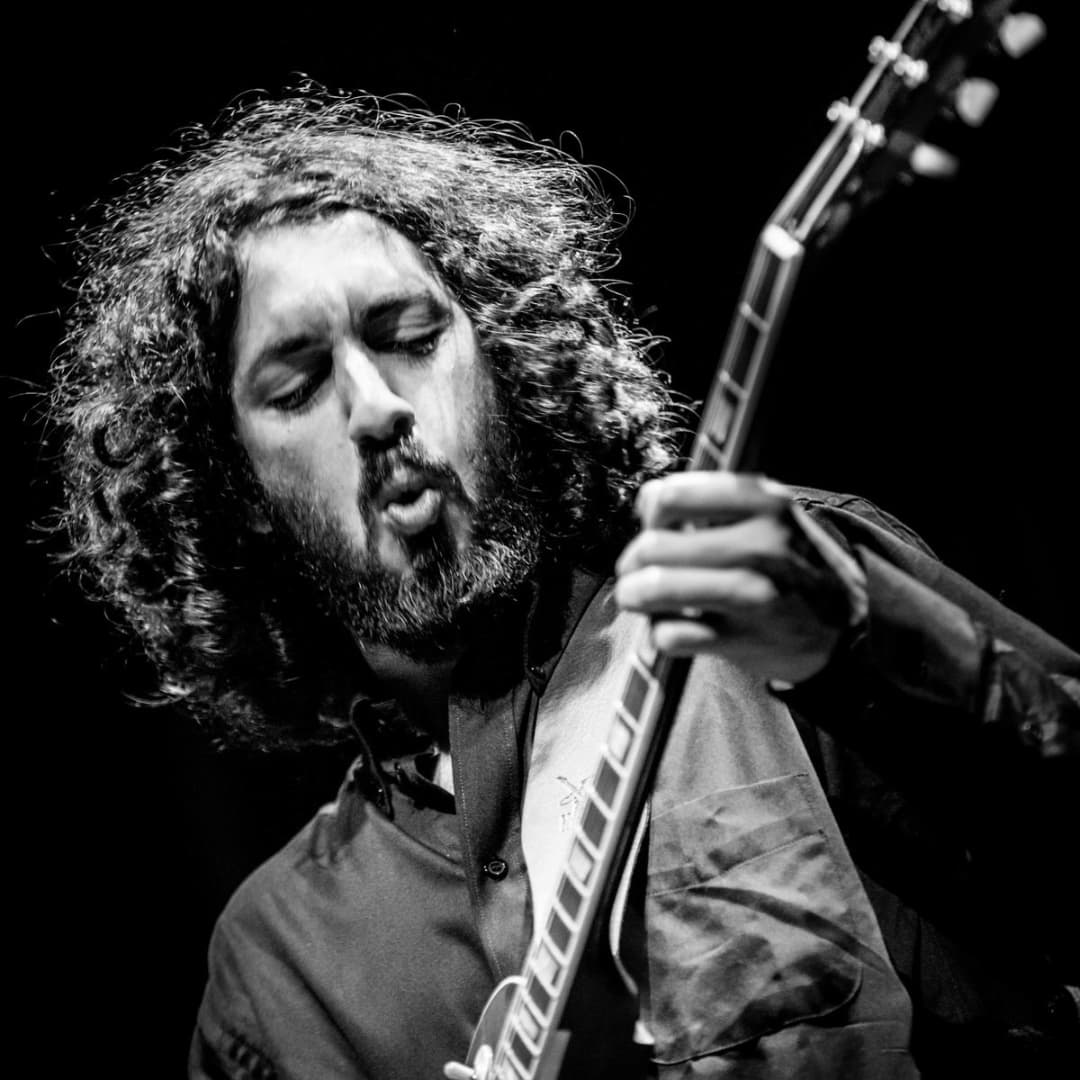
Biography
Kid Carlos has spent years building his own path within the blues scene from Guillena, Seville. A guitarist, singer and songwriter, he began his musical journey as a self-taught musician, discovering his passion for the guitar at a very young age and taking his first steps on stage through different local projects.
Since then, his relationship with blues has continued to grow without being limited to one single way of understanding the genre. In his music there is roots, craft and respect for tradition, but also a constant search for nuance, dynamics and new ways of telling stories through guitar and voice.
With Kid Carlos Band, one of his most important projects, he represented Spain at the European Blues Challenge 2024 and has continued to perform at festivals and venues both nationally and internationally. Throughout his career, he has also shared stages and recordings with artists such as Lluís Coloma, Lou Marini, Mike Vernon, Mingo Balaguer, Txako Jones and Quique Bonal, among others.
His journey is also reflected in a wide discography, closely connected to the blues scene. From releases such as Cannonball with Kid Carlos Band, to collaborations with Mike Vernon, Mingo Balaguer, Quique Bonal, Lluís Coloma and Lou Marini, Kid Carlos has steadily shaped a way of understanding blues based on roots, craft and listening. In recent years, he has also released works such as Live At Ruta 66 and Blues Medicine, consolidating a particularly active period both on stage and in the studio.
In 2026, he presents Kid Carlos Trio, a formation that allows him to explore his role as a songwriter and singer in greater depth. Alongside Lalu Cordón on bass and double bass and Stefano Di Rubbo on drums, he develops a repertoire of original compositions that open new paths within blues, incorporating influences from jazz, soul, funk and Latin rhythms.
The trio’s proposal is built around interaction between the musicians, careful attention to dynamics and a way of playing where expressiveness and musical dialogue matter more than virtuosity. It is a way of understanding blues as something alive: with space to breathe, to listen and to let each song find its own pulse.
Hueco Session #12
Kid Carlos recorded a live session at Hueco Studio in November 2026 as part of the Hueco Sessions in Cantillana, near de Sevilla.
Kid Carlos at Hueco Studio: the blues is never played the same way twice
Some music makes more sense when you hear it up close. Blues is one of those genres. A guitar, a few musicians playing together and enough room for improvisation to turn a familiar song into something different every night.
Kid Carlos joined us at Hueco Studio with Lalu and Estéfano for Hueco Sessions #12. This time, we started at lunchtime, with homemade rice on the rooftop, a little autumn sunshine and plenty of time to hang out before the concert.
After the performance, we sat down to talk about his early days in Guillena, the guitarists who inspired him, the blues scene in Seville and everything he has learned over the years.
A guitar at home and a bluesman from Chicago
Kid Carlos’s musical journey began in Guillena, a town near Seville. His father, a passionate music lover, bought an electric guitar and an amplifier hoping to learn how to play. Carlos was twelve years old and quickly became fascinated by the instrument.
Deep Purple, Led Zeppelin and other classic rock bands were regularly playing at home. Without knowing any chords or even how to hold the strings properly, he tried to recreate the sounds he heard on those records.
“I saw it as a toy.”
Back then, there were no YouTube tutorials or instant access to thousands of lessons. Learning meant listening carefully, watching other musicians and spending countless hours figuring out how the guitar worked.
One of his most important early experiences was seeing Chicago blues guitarist Jimmy Johnson perform in Seville. Carlos attended two of his concerts with his father.
“I was blown away and thought: I want to do this. This is cool.”
Not long afterwards, they travelled to Barcelona to see Eric Clapton. Between those concerts, the records at home and his first experiences playing with other musicians, blues gradually became a central part of his life.
And despite all the years of lessons, concerts and projects that followed, Carlos still sees something playful in the instrument.
“You can also see the guitar as a toy, where you keep moving through different stages and levels.”
The same song never sounds the same twice
After so many years of playing, improvisation remains one of the things Kid Carlos enjoys most about music.
For him, blues has its structures, rules and traditions, but it also leaves plenty of room for musicians to express themselves. A guitar phrase might take one direction during a concert and become something completely different the following night.
“You can’t play it exactly the same way twice because it’s improvised.”
That freedom also makes performing with other musicians a continuous learning experience.
Throughout his career, Carlos has shared the stage with artists such as Mike Vernon, Mingo Balaguer, Lluís Coloma and Quique Bonal, among many others.
Those experiences have taught him about music, but also about the relationships that develop between people playing together.
“Being a good person is also reflected in the music.”
Improvisation, after all, means listening to others, responding to their ideas and allowing their personalities to become part of the performance.
Respecting the roots without standing still
Blues is deeply connected to its history. Carlos compares it to flamenco and other traditional forms of music: styles with their own language and heritage, which are worth understanding before trying to transform them.
But respecting a tradition doesn’t necessarily mean repeating it in exactly the same way.
“Once you know it well, the ideal thing is to add your own touch and mix it with other influences.”
Although blues and American music have always been his main references, Carlos has also played rock, swing, flamenco, carnival music and many other styles.
During our conversation, we talked about how the places we grow up in influence the music we make. Carlos acknowledges that, however much he admires American musicians, his own background inevitably becomes part of his playing.
“I’m not American. I can’t play exactly like an American would.”
The records we listen to, the places we come from and the musicians we meet all find their way into our music.
Over time, those influences come together to create something personal.
The hardest thing is to move someone
At one point during the interview, we talked about virtuosity and the growing number of young guitarists showcasing incredible technical skills on social media.
For Carlos, mastering an instrument is important, but technical ability doesn’t necessarily mean the music will connect with someone.
“The hardest and most important thing is to move people emotionally.”
It’s a simple thought that says a lot about his approach to blues.
Playing fast, mastering scales or performing complicated passages can be impressive. But the real challenge, he explains, is making someone feel something when they listen.
“You have to try to move the person listening to you, and even yourself.”
Perhaps that’s one of the reasons blues works so well in intimate settings.
When a musician is just a few steps away, you can hear their breathing, watch their hands move and notice every small change in intensity.
It’s not necessarily better than a large stage, but it’s certainly a different experience.
Blues is still alive in Seville
Our conversation also turned to the blues scene in Spain, particularly in Seville.
Carlos describes a community of talented musicians, festivals and organisations working to keep the genre alive. He highlights La Casa del Blues de Sevilla, which organises concerts, workshops and activities and has helped encourage new bands.
However, he also recognises that attracting younger generations isn’t always easy.
Audiences at blues concerts and festivals tend to be older, and introducing the music to younger listeners remains a challenge.
Still, Carlos believes there will always be people willing to discover it. Musical tastes change over time, and sometimes all it takes is coming across an unfamiliar record to open the door to something new.
“Roots music can never die.”
He explains it through the image of a tree: if blues lies at the roots of jazz, soul, funk and rock, it’s difficult to imagine it disappearing while all those musical branches remain alive.
A conversation about music and artificial intelligence
This Hueco Session also brought something new to the format: for the first time, we invited the audience to join the interview and ask questions.
The conversation eventually turned to artificial intelligence and its growing presence in music.
We talked about AI-generated songs, the future of traditional music and whether technology could ever replace the work of musicians who have spent years learning their instruments.
Carlos acknowledges how impressive the technology has become and recognises its potential as a useful tool.
But he also believes it’s important to value human creativity and remember what happens when musicians perform in front of other people.
“What we experienced here today, for example, AI couldn’t do.”
Despite all the technological possibilities, the conversation kept returning to the same things: emotion, interpretation and the shared experience of live music.
Valve amplifiers, pedals and digital tools
There was also time to talk about guitars, amplifiers and effects.
Carlos combines traditional recording techniques, such as placing a microphone in front of an amplifier, with modern digital equipment that he uses for demos, videos and online lessons.
One of his tools is the Fractal FM3, which allows him to work with amplifier simulations and effects directly through his computer.
For blues performances, though, he still prefers valve amplifiers, particularly because of their dynamics and responsiveness.
During the session, he used a vintage Deluxe Reverb amplifier alongside an analogue pedalboard with overdrive, delay, reverb, tremolo, wah and other effects.
It’s a combination of traditional and modern equipment, where the tools themselves matter less than how they’re used to develop a personal sound.
New songs and finding his voice
Although he has spent many years performing and continues working with his band and other projects, Carlos is increasingly interested in focusing on his own compositions.
During the interview, he told us about plans to record a new album in Madrid with musicians based there.
“I’ve realised that what fulfils me most is playing my own compositions, my own songs.”
He’s also beginning to sing more, something he still considers part of an ongoing learning process.
There’s something refreshing about hearing a musician with so much experience talk about new challenges with the same enthusiasm he brings to remembering his first guitar.
Perhaps that’s one of the best ways to keep making music: never losing the desire to learn.
Kid Carlos Trio at Hueco Sessions
Kid Carlos Trio’s visit was a good excuse to spend an entire day enjoying blues music.
We started with lunch on the rooftop, followed by an intimate concert, cocktails and plenty of time to talk and spend the afternoon together.
It was Carlos’s first experience performing in this kind of setting, recording live inside a studio with an audience.
“A very welcoming place with great energy and a wonderful audience. There aren’t many people, but they’re the best.”
Throughout the interview, we talked about the difference between listening to music and experiencing it up close.
And that’s exactly what we try to create with Hueco Sessions: a place where musicians and audiences can share music without too much distance between them.
Because some things can be preserved in a recording, while others only happen in the moment.
And that afternoon in Cantillana, we were lucky enough to experience a little of both.