
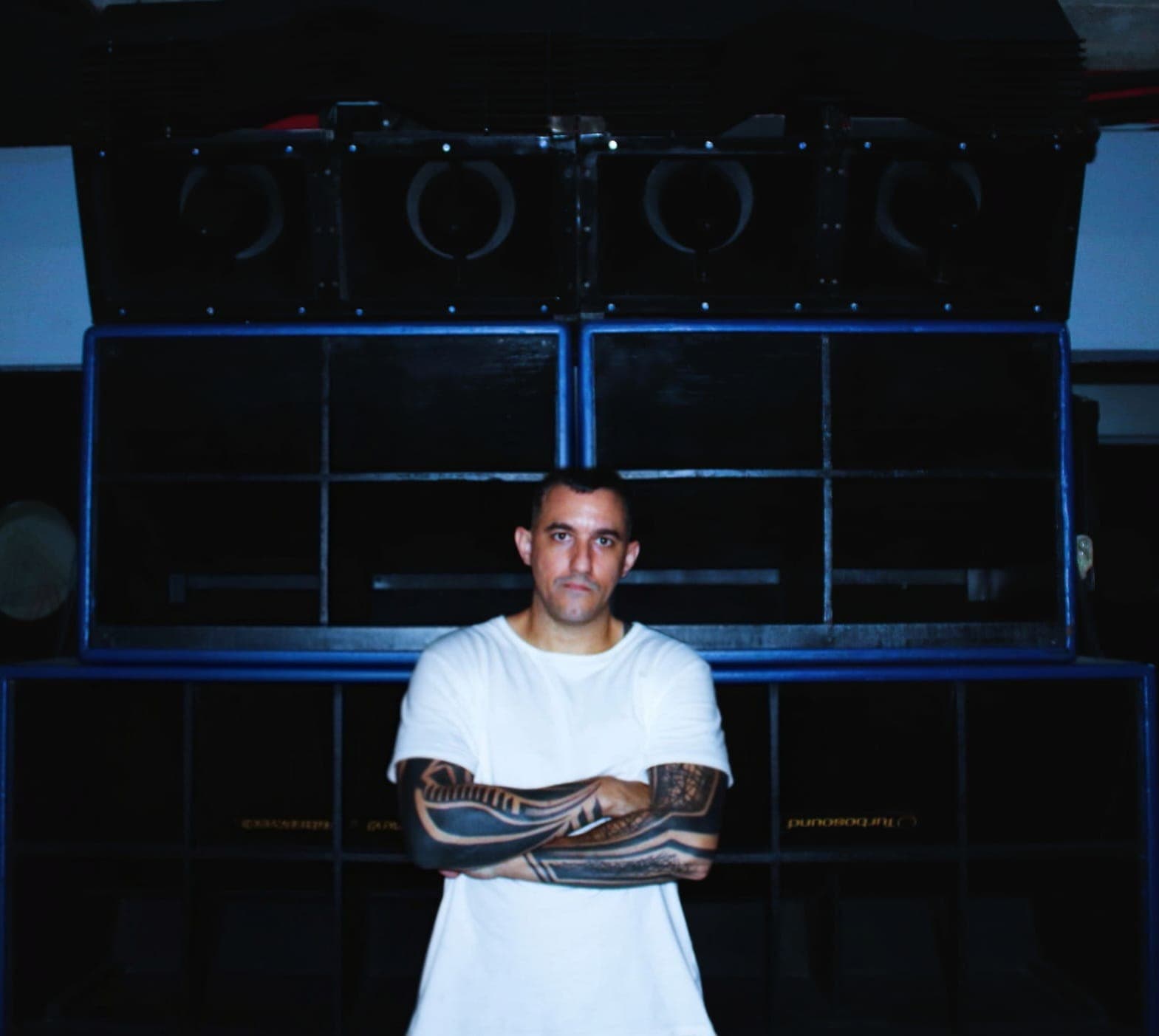
Biography
Celine Arnauld is the artistic name of Pablo Miranda Caballero, an electronic music producer whose work spans IDM, ambient, drone and glitch. His sound explores textured atmospheres, detailed rhythms and experimental structures, always seeking new ways to blend emotion with abstraction.
He has released music on a wide range of labels, including Zabra Records, EVEL, Clean Error Records, Welsh Modular Alliance, Kahvi Collective, New York Haunted, Point Source Electronics Arts, Moatun 7, Polygon Network and Opal Tapes — showcasing the diversity and consistency of his work within the experimental electronic scene.
Hueco Session #05
Celine Arnauld recorded a live session at Hueco Studio in December 2025 as part of the Hueco Sessions in Cantillana, near Seville.
Celine Arnauld at Hueco Studio: ambient, machines and the art of letting go
Some live shows are made to lift the audience up. Others, instead, invite you to slow down, listen differently and gradually enter a sonic landscape.
Celine Arnauld’s session at Hueco Studio belonged to the second kind. An intimate, textural and immersive ambient live set, built from machines, samples, layers and smooth transitions. Music that does not need to impose itself in order to fill the space.
After the performance, we sat down with Pablo, the person behind Celine Arnauld, to talk about electronic music, ambient, hardware, Octatracks, production, Seville and that way of creating where intuition matters more than a fixed idea.
An ambient live set in an intimate space
For Pablo, playing at Hueco Studio was an unusual experience. Used to venues, clubs and spaces more connected to dance music, finding himself in an intimate afternoon format, with the audience close by, felt different.
“An intimate, beautiful place, and I felt very comfortable.”
In Seville, he explains, there is not much of a circuit for this kind of proposal. Electronic music is usually more associated with night-time, clubs and dancing. An ambient live set in the afternoon, in a studio, with people sitting and listening closely, is not something that happens every day.
“Everything is more focused on dance-oriented electronic music and going out at night.”
That is why the session felt special. It was not a dancefloor, a dark room or a club. It was another kind of listening: slower, closer, more attentive to detail.
From bakalao to ambient
Pablo’s relationship with electronic music began very early. Like many people from his generation, the first CDs arrived when he was almost a child: mákina compilations, bakalao, breakbeat and all that music that circulated from hand to hand before discovering new sounds became as immediate as it is today.
Alongside that, he was also listening to punk, hardcore and other more aggressive styles. Little by little, that mixture began to open new paths.
“You start discovering little things you like, and you get deeper and deeper into it.”
From more commercial music, he moved towards Orbital, breakbeat, less obvious sounds and, over the years, more experimental territories. Ambient and IDM did not arrive all at once, but as part of a slow search: listening, trying things out and finding new languages.
Creating without a fixed idea
One of the keys to Celine Arnauld lies in Pablo’s way of producing. He does not usually sit down with a closed idea of what he wants to make. He does not start from a rigid concept or a clear destination. Instead, he opens the space and sees what happens.
“I just sit down and see what comes out.”
When he works with synthesizers, the process is close to a jam: improvising, trying sounds, recording if something interesting appears and moving on if it does not. When he works on the computer, the method changes slightly, but the attitude remains the same: letting the music take shape.
“I don’t sit down and say: I want to make this. It’s simply whatever comes out.”
That way of creating can be felt in his music. His pieces do not seem built to reach a specific point quickly, but to unfold gradually. Textures, atmospheres, low frequencies, pads and small movements that slowly find their place.
Between hardware and computer
Although he has worked a lot with machines over the years, Pablo does not close himself off to any tool. In the Hueco Studio session, old pieces were played, recovered and adapted for the live set, alongside more recent material created in Ableton and with virtual synthesizers.
“I don’t close myself off to anything, just whatever I feel like doing.”
For a while, hardware was a central part of his process. But lately he has returned more to the computer, because it allows him to capture ideas faster and develop them in a more direct way.
Still, Celine Arnauld does not frame this as a battle between analogue, digital, hardware or software. The tool matters, but not more than the music it allows you to make.
Two Octatracks at the centre of the live set
For this session, Pablo came with two Elektron Octatracks. Two machines he has been using for years and that have become the centre of his live setup.
The Octatrack allows him to work with previously produced material, but also to manipulate it, modulate it and transform it in real time. It is not simply about launching tracks, but about having room to change sounds, add layers, modify sequences and build fluid transitions.
“The sound can change if I want it to.”
One of the reasons he uses two Octatracks is precisely the possibility of creating a compact live set, with smooth transitions and a feeling close to a DJ set, but with much more intervention on the material.
“I’ve managed to create a live set that sounds good, compact and as close as possible to a DJ set.”
In music like his, where the flow matters as much as each individual piece, that continuity is essential. One track enters another without breaking the atmosphere. The session moves forward like a single journey.
The ear as a compass
When talking about sound, Pablo returns again and again to one simple idea: trying things out.
There is no exact formula for knowing when a sound works. It might be a sub bass, a percussion element, a pad or a melody. What matters is listening to how it fits with everything else.
“Trial and error.”
In the mixing phase, a more technical side also appears: looking at the spectrum, checking that everything is balanced, adjusting frequencies. But in the moment of creation, the main compass is still the ear.
“When it comes to fitting sounds together, in the end it’s all about the ear.”
That intuitive relationship with sound fits very well with the kind of music he makes. Ambient, IDM, glitch, experimental electronics: genres where detail, texture and balance matter as much as structure.
Electronic music and prejudice
The interview also touched on a common question when talking about electronic live sets: what about those who think that if you are not playing an acoustic instrument live, you are not really making music?
Pablo admits that he himself thought something similar as a teenager.
“I thought like that when I was 15 or 16.”
But over time, that view changed. Electronic music involves a huge amount of previous work: composition, sound design, sequencing, mixing, synthesis, structure, live performance. There may not always be a guitar in someone’s hands, but that does not mean there is no interpretation, decision-making or risk.
“Everything we hear in electronic music has previous work behind it.”
And sequencing does not mean you stop intervening. On the contrary: it can open up space to modify, mix, transform and take a live set to places that would be impossible to perform with two hands and a single instrument.
“It is a way that gives you more freedom to do more things.”
Maybe that is one of the central ideas of his live performance: not playing in the most traditional sense, but manipulating, ordering, transforming and holding a moving sonic landscape.
Seville, electronic music and other circuits
Although Pablo does not feel that Seville directly determines the kind of music he makes, he recognises that the place where you live always leaves some kind of trace.
The city is not naturally associated with ambient or experimental electronic music. It has other stronger imaginaries, other traditions, other circuits. But precisely for that reason, opening spaces for this kind of music also feels necessary.
“In the end, that influences you and it is there, and that is not a bad thing.”
At Hueco Studio, Celine Arnauld’s live set felt almost like a beautiful exception within that context: a pure ambient session in a small space, in the afternoon, with focused listening and without the need to turn electronic music into a party.
A sonic archive in motion
The Celine Arnauld project began to take shape around 2018 or 2019. Before that, there had been other aliases, other styles, even more aggressive music such as hardcore or breakcore. But under this name, Pablo began releasing music more consistently from 2020 onwards, with records on labels from Barcelona and Portugal, including a vinyl record made during the pandemic.
If someone discovers his music now, he recommends listening both to his early works and to the latest things he has released, because that is where the evolution can be heard: the passing of time, the change in sound, the interest in mixing and the search for a more defined identity.
“The most complicated thing is knowing how to mix all those ideas and make them sound good.”
That learning process can also be heard in the session. Old material recovered, new pieces, adapted tracks, sounds modulated for the live set. Celine Arnauld does not present closed music, but a living archive that can return, change and find another form on stage.
Ambient to listen differently
Celine Arnauld’s session at Hueco Studio was the first pure ambient session within the project. And that makes it something special within Hueco Sessions.
There was no band, no vocals, no choruses and no recognisable structure of a traditional concert. There were machines, layers, low frequencies, textures and a different way of inhabiting time.
Music that invites you to listen to the details. To enter slowly. To let the sound do its work.
Pablo closed the interview by thanking the space and encouraging other bands and artists to come to Hueco Studio:
“The place is fantastic, really beautiful, welcoming.”
Celine Arnauld left us with an intimate, immersive and very unusual session within the Seville context. A conversation about electronic music, ambient, production, machines and listening. And a live set that reminded us that sometimes music does not need to push: it is enough to open a space and let the sound breathe.